
Ingredients & origin
Three Ingredients, Centuries Apart
Two Korean botanicals, one piece of modern formulation, and why they’re in the same bottle.
September 2026 / JEJU GLOW Journal
In this note
Three Names
There are three names on the front of Beach Glow Oil. Camellia. Balsam. Peptide Complex.
Two of them have been part of Korean beauty for centuries. The third didn’t exist when either of us was born.
That gap is the point.
Camellia 동백
Camellia is where the brand starts, and it’s the reason we started on Jeju.
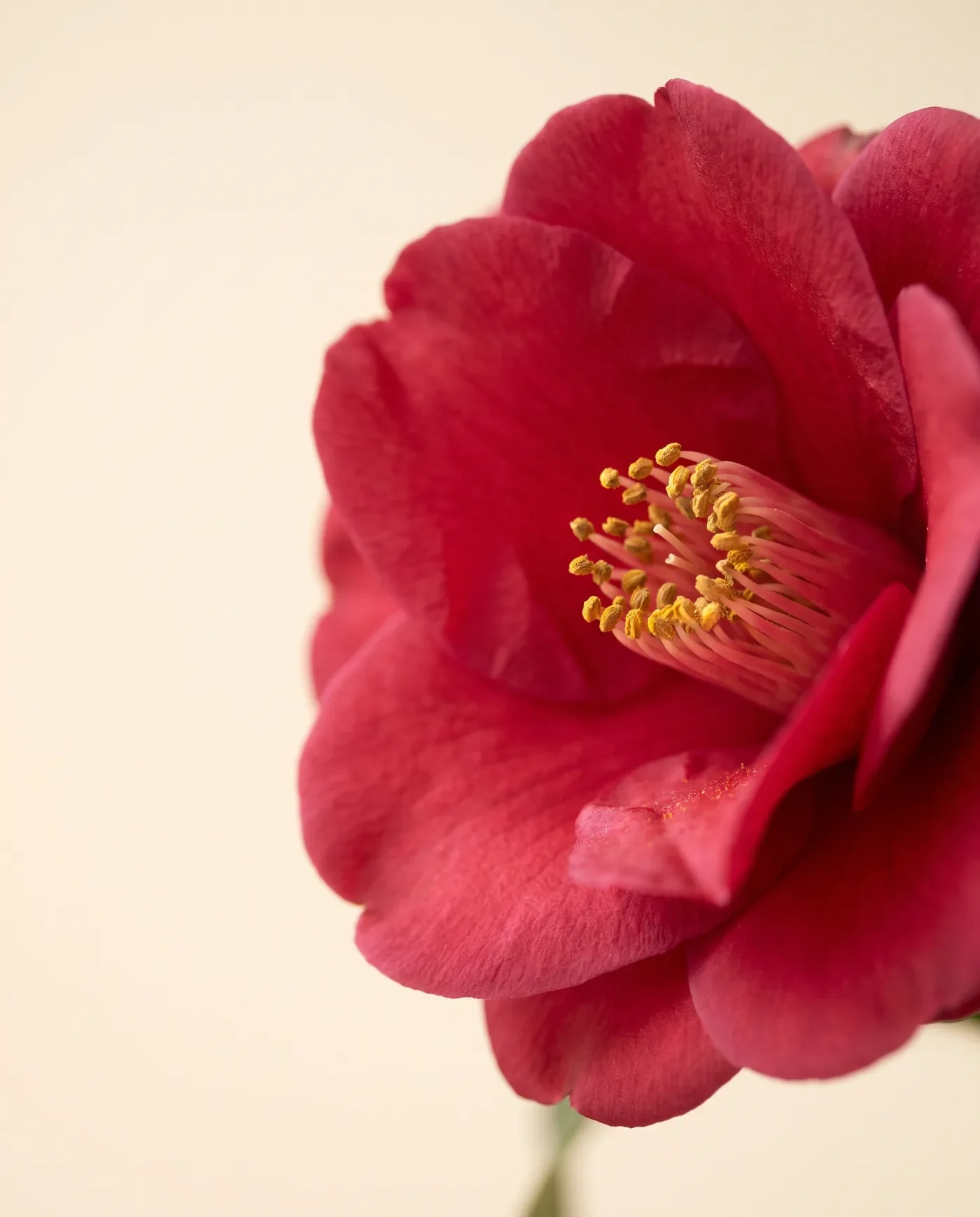
동백 (dongbaek), in Korean. The tree grows across the island — dark glossy leaves, red flowers in winter, seeds pressed for oil. It has been used on skin and hair here for a very long time, long enough that it shows up in poems and paintings before it ever appeared on an ingredient list.
What made it right for this product wasn’t the history, though. It was how it behaves.
Camellia oil is unusually light for a plant oil. It spreads easily and doesn’t linger on the surface the way heavier oils do. When we began working on an oil that had to feel dry, it was already closer to the answer than most of the alternatives.
An oil that people chose for centuries because of how it felt, chosen again for the same reason.
Balsam 봉선화
봉선화 (bongseonhwa). Garden balsam, or Impatiens balsamina — the second botanical, and the one most people outside Korea won’t recognise.
Inside Korea, almost everyone does.
It’s a flower woven into Korean summers. Children crush the petals and bind them to their fingernails overnight, and the colour that follows is tied to an old belief about waiting: if it lasts until the first snow, your first love comes back to you.
What we take from the plant is an extract, used here as a skincare ingredient — the same botanical, read through modern formulation rather than inherited practice.
Sourced from the Korean peninsula. Camellia from Jeju, balsam from the mainland — an island ingredient and a peninsular one, chosen the same way. Jeju is where this brand began and where its imagination lives, but Korea is a country with a long list of things worth putting on skin, and we draw on all of it.
The Peptide Complex 펩타이드
The third ingredient is the one that breaks the pattern.
Peptides have become standard in facial skincare. If you own a serum, you almost certainly own peptides. They’re one of the ingredients that built K-Beauty’s reputation.
Below the neck, they show up far less often. Body products tend to be formulated as finishing steps — something applied at the end, for how it looks and smells — rather than as skincare in its own right.
We never debated whether to include a peptide complex. Once we’d decided this was skincare, it followed.
And there’s something else in it. If we’re going to make a Korean product and put it in front of people who buy K-Beauty because of what Korean formulation has done for their skin, then the good ingredients should come with it.
Not the version that stops at the jawline. The whole thing.
Centuries Apart
Two of these ingredients were chosen by people who had no laboratory and no ingredient list, working from nothing but how something felt on skin and what it did over a season.
The third came from the opposite direction entirely.
We like that they’re in the same bottle. Korean beauty has always been both of these things at once — a very old set of habits and a very new set of tools — and the interesting part is what happens when you stop treating them as separate traditions.