
Texture & formulation
The Weight of Oil
What it took to make a body oil feel dry.
September 2026 / JEJU GLOW Journal
In this note
Too Heavy
The first sample was too heavy.
It looked right. But it sat on the skin the way most oils do — a layer you could feel for an hour afterward, the kind that finds sand the moment you sit down.
We’d said from the start that this was the part we cared about most. So we sent it back.
Why Dry
A day at the beach isn’t a spa day. You put the oil on, and then you keep going — you sit down on a towel, pull a rash guard back on, pick up your phone, get into a car that’s been in the sun all afternoon. Anything that stays on the surface ends up on all of it.
That was part of it. The other part was a standard we brought with us.
Korean skincare has always been particular about texture. Routines are built in layers, and layers only work when each one settles before the next. Heavy, lingering finishes have never fit that way of thinking. We grew up with a particular expectation of texture in Korean skincare: products should settle, then make room for what comes next.
Something you could put on and then stop thinking about — until the light caught your shoulder.
Three Things at Once
It took four rounds of samples to get here, and most of that time went into one problem.
We wanted three things from the formula, and they pull against each other.
We wanted it dry — genuinely dry, not dry for an oil. We wanted it made from ingredients we’d be comfortable putting on skin across a whole back and shoulders. And we wanted it at a price that made sense for something you use every beach day, not once a season.
Any two of those are easy. All three at once is where the work is.
What Makes an Oil Feel Dry
“Dry oil” isn’t a technical term, and there’s no standard for it. Nothing evaporates. It describes how quickly an oil spreads and how little it leaves on the surface — a fast-spreading oil goes on thin, and a thin layer is one you stop noticing.
Plant oils don’t do that on their own. Even the lighter ones, camellia among them, leave more behind than most people want at the beach. What makes a body oil feel dry is the balance around them: lighter ingredients that spread fast and sit thin, carrying the plant oils that give the formula its character.
The base holds organic sunflower seed oil alongside camellia, olive, argan, and rosehip. The full ingredient list is on our site. We’d rather you read it knowing why each thing is there.
What We Took Out
One ingredient in the early formula had to go: isopropyl myristate. It gave the formula beautiful slip, but it also carries a long-standing concern for people prone to body breakouts — especially where oil is applied across the back and shoulders.
Taking it out meant paying more per bottle, and it risked giving back some of the dryness we’d worked for. The lighter esters that replaced it held the texture almost exactly where it was.
That was a cost we were glad to take on.
What We Added Back
Partway through, we went back and asked for more camellia.
It was already in the formula. It’s the ingredient the brand began with. But at the level it started at, it felt more like a mention than a presence. Raising it cost more per bottle, and we agreed to that without much debate.
We also had to solve for heat. This is a product that will sit in beach bags and hot cars, and oils change when they’re kept warm for long enough. We’d hoped to use rosemary extract to help keep the oil itself stable, but there wasn’t a version that worked in a formula like this one. So the tocopherol went up, and astaxanthin came in alongside it.
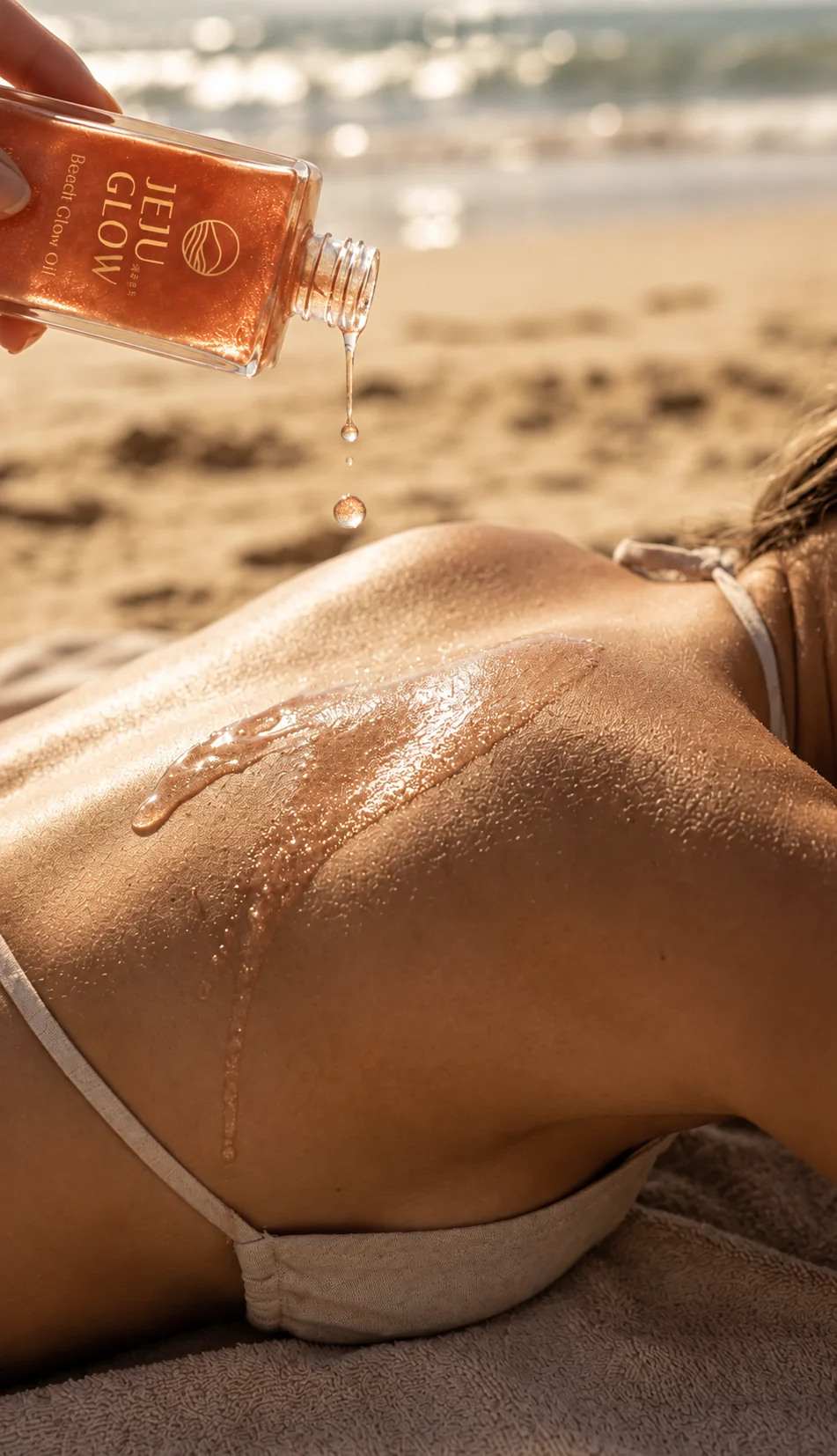
Astaxanthin is there to help keep the formula stable. The rose-gold colour you see in the bottle comes with it.
Where It Landed
Four rounds of samples later, that’s where it landed.
Not an oil that disappears, but one that leaves skin feeling like skin.